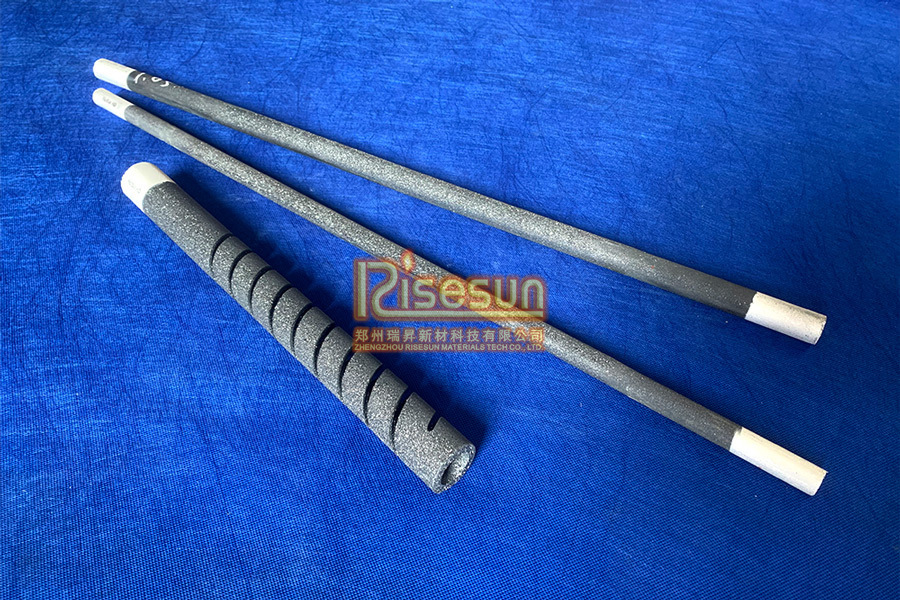
Along with the development of new materials, SiC heating elements are used more and more widely, meanwhile, the working conditions of SiC heating elements are getting worse and worse in some fields
Along with the development of new materials, SiC heating elements are used more and more widely, meanwhile, the working conditions of SiC heating elements are getting worse and worse in some fields, such as sintering of NCM811 and NCA, stronger corrosion atmosphere in the furnace, which press manufacturers of refractories, kiln furniture and heating elements to improve performance of their products continuously in order to match demands of the changing market. For that, we developed high density (HD type) SiC heating elements successfully, which has advantages of higher density, lower porosity, higher rupture strength, anti-corrosion and longer service life. Through lab tests and clients’ trial run, the service life of our high density SiC heating elements improved more than 50% under various working conditions, including comparisons in 1,530℃ intermittent furnaces, 1,400℃ continuous furnaces, furnaces with strong alkali atmosphere, etc. For example, after 4,200-hour continuous heating in the lab furnace with clean air, with the surface loading of 3.5W/cm2, the resistance of common elements increased by about 62% in total and 14.7% per 1,000 hours on average. For high-density heating elements, the resistance increased by approximately 32% only and 7.7% per 1,000 hours on average.
Physical properties of common (RH & RL) and high-density (HD) heating elements are compared in the table below.
Item
Unit
Model
DH & DL
Hotbar® HD
Density
g/cm3
2.5
2.65
Porosity
%
23
18
Rupture strength
MPa (25℃)
50
60
Thermal conductivity
W/m·℃ (1000℃)
14~19
14~19
Specific heat
kj/kg·℃ (25~1300℃)
1.0
1.0
Coefficient of linear expansion
(1000 ℃) × 10-6
4.5
4.5
Furthermore, HD elements have smoother resistance-temperature curves. Assuming 1.0Ω resistance at 1,000℃, temperature-resistance variations of common and HD elements at different temperatures are shown in the table below:
Temperature ℃
25
200
400
600
700
800
900
Common element
1.5~4.0
2.20
1.50
0.80
0.84
0.89
0.93
HD element
1.3~2.0
1.80
1.30
0.81
0.85
0.90
0.94
Temperature (℃)
1000
1100
1200
1300
1400
1500
Common element
1.00
1.06
1.14
1.23
1.32
1.40
HD element
1.00
1.06
1.12
1.17
1.19
1.22
Seen from the above table, firstly, the resistance consistency of HD elements is better at low temperatures. As a result, furnaces will get a better temperature consistency at low temperatures; secondly, the resistance variation of HD elements is smaller at high temperatures, especially at temperatures above 1,200℃, which will provide a longer service life at high temperatures.
Furthermore, considering its characteristics of raw materials and high density, HD elements may be produced with much lower resistance than that of common elements. For example, for diameter 30mm heating elements with 1000mm hot zone, the minimum resistance of common elements is approximately 1.2Ω, but that of HD elements is 0.9Ω or less, thus providing more options for the electrical system design of kilns and furnaces, such as connection of more heating elements in series. Of course, we can also produce HD elements with higher resistance than common elements to satisfy customer needs.